
AI, DATA SOVEREIGNTY, AND THE ARCHITECTURE OF CONTROL
By Zohaib Ahmed | 30th September 2026
Executive Summary
Pakistan’s recent bilateral engagement with the Bill Gates Foundation, centered on agricultural modernization through hybrid seeds, biotechnology, and precision farming technologies, represents a critical sovereignty threshold. While framed as development assistance, this partnership embeds Pakistan’s agricultural system into an architecture of external control operating through three interconnected mechanisms: proprietary seed systems that eliminate farmer autonomy, AI-driven agricultural monitoring that extracts data from Pakistani farmland, and digital infrastructure that concentrates decision-making authority in foreign-controlled systems.
When contextualized within documented patterns of agricultural weaponization in great power competition, this partnership transforms Pakistan’s food system from a domain of strategic autonomy into a domain of structural dependency.
This paper argues that Pakistan must reject this partnership and instead invest in domestically controlled agricultural systems that preserve both technological improvement and strategic sovereignty.
The timing is significant. The Gates Foundation has committed to spending more than USD 200 billion between 2025 and 2045 before closing its operations. Agriculture in low- and middle-income countries is one of the Foundation’s principal areas of focus. In 2026, the Foundation also committed USD 1.4 billion over four years toward climate adaptation for smallholder farmers and announced, with Google, more than USD 100 million in combined funding and technical support for AI tools intended to reach 200 million smallholder farmers across Sub-Saharan Africa and South Asia.
Pakistan’s September 2026 engagement therefore occurs within a much larger expansion of agricultural technology, AI, data and climate-resilience programmes across the Global South.
The strategic question is not whether these technologies work.
The question is who owns the infrastructure through which they work.
METHODOLOGY
Literature Review and Strategic Analysis
This paper uses a qualitative literature-review methodology combining policy documents, institutional publications, academic research, corporate disclosures, development literature and strategic-security analysis.
The research was structured around five evidence domains.
1. Official Pakistan Government Documents
The research examined official Pakistani government statements concerning the September 2026 meeting between Prime Minister Shehbaz Sharif and Bill Gates, including the stated areas of cooperation in agriculture, biotechnology, improved seeds, livestock genetics and emerging agricultural technologies.
The analysis also considered Pakistan’s existing agricultural institutions, seed regulation, public-sector research capacity and national agricultural policy environment.
2. Gates Foundation Documentation
The research examined Gates Foundation publications concerning:
- agricultural development
- crop breeding
- seed systems
- climate adaptation
- agricultural data
- digital farmer services
- artificial intelligence
- South Asia
- smallholder agriculture
- the Foundation’s 2045 closure strategy
Particular attention was given to the Foundation’s current agricultural and AI commitments because the strategic importance of the Pakistan relationship cannot be understood separately from the Foundation’s broader global agricultural strategy.
3. Academic and Development Literature
Academic literature was reviewed concerning:
- hybrid seed adoption
- farmer seed-saving practices
- agricultural intellectual property
- genetic-resource governance
- seed-market concentration
- agricultural technology adoption
- farmer income and input costs
- public versus private agricultural research
Literature concerning the experience of agricultural transformation programmes in Africa was also reviewed, particularly research examining the outcomes and limitations of initiatives associated with the Alliance for a Green Revolution in Africa.
4. Agricultural Supply-Chain and Corporate Documentation
Corporate disclosures were examined to establish the existing participation of multinational corporations in Pakistan’s agricultural economy.
Cargill was examined specifically because its operations demonstrate how multinational participation already extends beyond agricultural inputs into commodities, oilseeds, animal feed, palm oil, storage, port infrastructure and agricultural logistics.
5. Strategic and Geopolitical Analysis
The final layer connected agricultural dependency with the Agrorism framework.
The analysis considers agriculture as critical infrastructure and examines how dependency on seeds, agricultural inputs, data, logistics and digital decision systems can create strategic vulnerabilities during geopolitical competition.
The methodology therefore does not treat the Gates Foundation relationship as an isolated philanthropic programme.
It analyzes the partnership as part of a wider agricultural system.
The central analytical question throughout the literature review was:
Does technological modernization increase Pakistan’s autonomous agricultural capacity, or does it increase Pakistan’s dependence on external systems?
PART I: THE GATES FOUNDATION AGRICULTURAL PARTNERSHIP AND THE ARCHITECTURE OF CONTROL
A. The Official Framework and Its Hidden Structural Implications
The bilateral meeting between Prime Minister Shehbaz Sharif and Bill Gates in September 2026, on the sidelines of the United Nations General Assembly, initiated formal discussions on expanding Pakistan’s relationship with the Gates Foundation into agriculture.
Official messaging emphasizes climate resilience, yield improvement, biotechnology, research and capacity-building.
The Pakistani government specifically identified improved seeds, livestock genetics and emerging agricultural technologies as areas for future cooperation.
This is being presented as agricultural modernization.
However, the framework obscures the structural dynamics of the partnership.
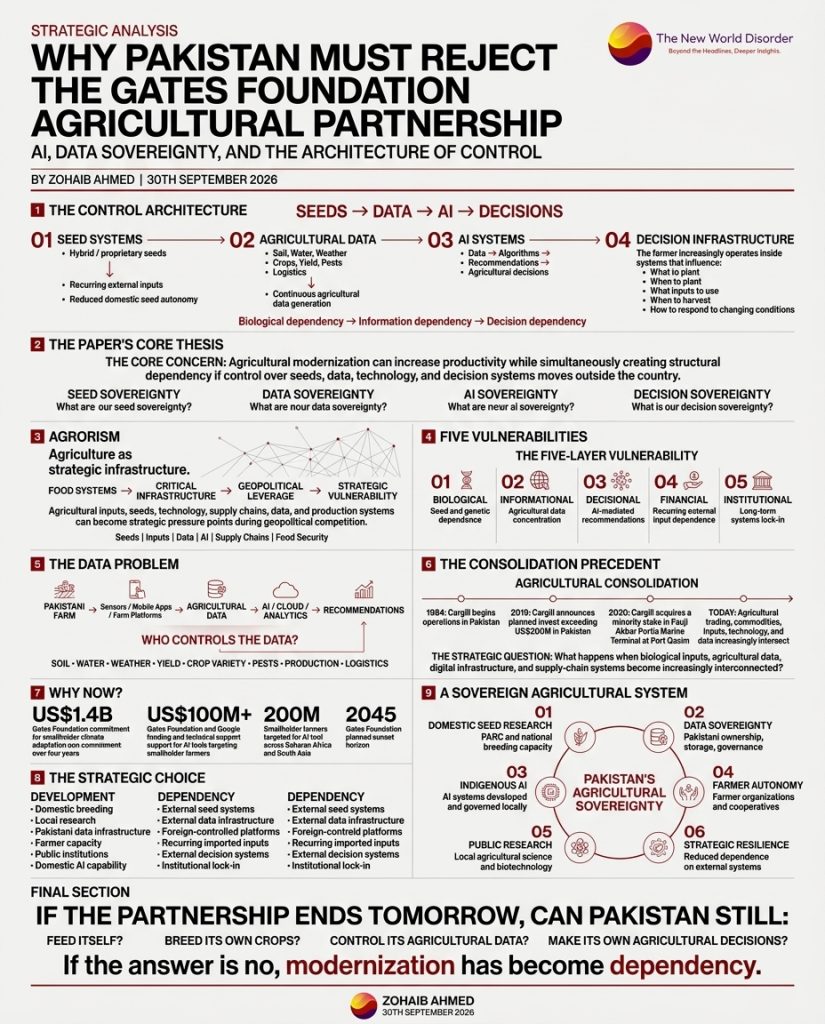
What appears as technology transfer actually functions as the installation of a control architecture.
This architecture operates through three interconnected systems.
First, proprietary seed systems create biological dependency.
Hybrid and genetically engineered seeds cannot be saved and replanted by farmers. This biological constraint forces annual purchases from foreign seed suppliers, converting agriculture from a semi-autonomous production system into a market-dependent commodity relationship.
Second, digital agricultural monitoring systems generate continuous data streams from Pakistani farmland.
Precision agriculture, farm management software, IoT sensors, satellite imagery and digital advisory systems transform farms into continuously monitored data environments.
Third, AI-driven decision systems operate as the interpretive layer.
Raw agricultural data has limited value without systems capable of translating it into recommendations. AI systems increasingly determine when to plant, what to plant, when to irrigate, how to respond to weather and disease risks, and how to optimize production.
Collectively, these three systems create what might be termed agricultural governance at a distance.
The ability to shape agricultural outcomes does not require direct political governance.
It can operate through control over inputs, information flows and decision systems.
B. Understanding the Seed System as Control Infrastructure
The Gates Foundation’s primary agricultural instrument is the promotion of hybrid and genetically modified seed systems.
The foundational logic is straightforward: hybrid seeds produce superior yields and therefore represent agricultural progress.
However, hybrid seeds function simultaneously as a control technology.
Hybrid seeds are sterile or produce offspring with degraded characteristics. Farmers cannot save seeds from hybrid crops for subsequent planting. They must purchase new seed stock annually.
This biological fact creates an economic structure in which farmers become permanent consumers of a commodity produced and controlled by external corporations.
The Gates Foundation has invested billions of dollars globally in agricultural development, with major emphasis on improved seeds, crop breeding, seed systems, climate resilience and agricultural research in Sub-Saharan Africa and South Asia.
The Foundation’s own agricultural development programme seeks to accelerate crop-breeding cycles dramatically, reducing development timelines from approximately 20 to 30 years toward five to ten years.
This represents enormous technological capacity.
It also represents enormous influence over the direction of agricultural innovation.
For Pakistan specifically, hybrid seed adoption would convert the nation from a position of relative seed autonomy, supported by public institutions such as PARC and national seed resources, into a position of structural seed dependency.
Within a decade, as local seed production capacity atrophies and farmer knowledge of seed-saving practices erodes, this dependency would become increasingly difficult to reverse.
The financial extraction is substantial.
Pakistan cultivates approximately 24 million hectares of cropland. Conversion to hybrid systems would create annual seed expenditures of approximately USD 800 million to USD 1.2 billion, paid to foreign seed corporations.
This represents a permanent transfer of agricultural surplus value overseas.
C. WHY GATES, AND WHY NOW?
The timing of the Gates Foundation’s expanding agricultural engagement with Pakistan requires particular attention.
The Gates Foundation announced in May 2025 that it intended to spend more than USD 200 billion over the following 20 years before closing in 2045.
In January 2026, the Foundation announced a planned annual payout of approximately USD 9 billion as part of this accelerated spending strategy.
Agriculture in low- and middle-income countries is one of the major areas receiving this funding.
The Foundation’s 2026 annual letter explicitly identifies South Asia and Sub-Saharan Africa as regions where agriculture is central to poverty reduction and economic development.
The Foundation also committed USD 1.4 billion over four years toward helping smallholder farmers adapt to climate change through better seeds, tools, climate-resilient crops, digital advisory services and agricultural innovation.
Then, on September 18, 2026, only days before the Pakistan meeting, the Gates Foundation and Google announced more than USD 100 million in combined funding and technical support for AI tools intended to reach 200 million smallholder farmers across Sub-Saharan Africa and South Asia.
The programme includes AI-powered agricultural mapping, crop monitoring, climate forecasting and crop-development research.
The scale is important.
The initiative is moving from an initial target of approximately 50 million farmers toward 200 million.
The Foundation describes the Agricultural Understanding Platform as an AI foundation-model suite capable of mapping field boundaries at sub-meter resolution and monitoring crops throughout growing seasons.
This is a fundamental transformation in agricultural information systems.
The Gates Foundation is therefore entering a period in which three priorities converge:
Agriculture.
Artificial intelligence.
South Asia.
Pakistan is located directly inside this strategic geography.
The Pakistani government is simultaneously seeking agricultural modernization through biotechnology, climate resilience, research, improved seeds, livestock genetics and emerging technologies.
The timing therefore represents a convergence between Pakistan’s demand for agricultural modernization and the Gates Foundation’s accelerated global deployment of agricultural and AI technologies.
The question for Pakistan is whether it becomes a technology recipient or develops the institutional capacity to control the technologies it receives.
D. Data Extraction and the Asymmetry of Agricultural Information
The precision agriculture component of the Gates partnership introduces data extraction at scale.
Precision agriculture systems operate through:
- sensor networks embedded in fields
- soil moisture monitoring
- temperature measurement
- nutrient analysis
- pest detection
- satellite imagery
- crop monitoring
- farm-management software
- weather information
- market data
- API integrations
- algorithmic recommendation engines
The result is that every agricultural decision made on Pakistani farmland can become mediated through data systems.
When to plant.
What to plant.
When to fertilize.
When to irrigate.
When to harvest.
How to respond to weather.
How to respond to disease.
The farmer generates the underlying data through their land and labor.
Foreign entities can own the technology that collects it.
Foreign entities can own the algorithms that analyze it.
Foreign entities can control the infrastructure that stores it.
Foreign entities can develop commercial products from it.
This creates an asymmetry.
Pakistan generates the agricultural data.
External systems can generate the intelligence.
The strategic implication is profound.
Agricultural data generated across Pakistan’s farmland becomes intellectual property of foreign corporations. Over time, this data accumulates into predictive models of Pakistani agriculture: what grows where, under what conditions, what yields are optimal, where vulnerabilities exist and how production responds to environmental conditions.
These models become strategically valuable.
They can forecast agricultural capacity, identify vulnerabilities and plan interventions.
E. AI Systems as Decision Infrastructure
The AI component of precision agriculture operates as the decision-making layer.
Raw data from sensors is insufficient.
It must be interpreted through analytical frameworks.
These frameworks are increasingly algorithmic.
Machine-learning systems are trained on historical and real-time data to predict optimal outcomes.
Who controls these algorithms controls agricultural decision-making.
If a farmer receives an algorithmic recommendation to plant on a specific date, apply fertilizer at a specific rate or irrigate at specific intervals, the farmer’s agency is increasingly mediated through the system.
The underlying logic can be opaque.
Algorithmic opacity is endemic to many machine-learning systems.
Gates Foundation partnerships increasingly involve AI-enabled agricultural systems, digital advisory services and agricultural technology ecosystems operating across developing countries.
The strategic concern is therefore the emergence of agricultural decision systems controlled outside Pakistan.
These systems could become trained on Pakistani agricultural data while remaining proprietary.
Pakistan could become dependent on algorithms it does not own, cannot independently audit and cannot easily replace.
The strategic implication is straightforward.
If external actors control AI systems advising Pakistan’s farmers, they possess influence over agricultural outcomes at scale.
They can recommend suboptimal planting patterns, delay harvests, recommend crop varieties that serve external interests rather than Pakistani interests, or create dependence on the systems themselves.
As documented in the Agrorism framework, agricultural systems are increasingly recognized as critical infrastructure amenable to manipulation for geopolitical leverage.
Control over the AI systems that advise farmers is control over agricultural outcomes at scale.
F. The Integration: How Three Systems Create Unified Control Architecture
The power of the Gates Foundation model lies in the integration of three systems.
Hybrid seeds create dependency on annual purchases.
Data systems extract information from Pakistani farmland.
AI systems interpret that information and recommend actions.
A farmer in Punjab cannot save seeds from their hybrid crop, so they must purchase from foreign suppliers.
They use precision agriculture systems to monitor their fields, generating data that flows to foreign servers.
They receive algorithmic recommendations that advise when and how to use the seeds they purchased.
This is not three separate systems.
It is a unified architecture in which each component reinforces the others.
The farmer’s autonomy is progressively constrained across multiple dimensions:
Biological autonomy: cannot save seeds.
Informational autonomy: data is extracted.
Decisional autonomy: agricultural decisions become AI-mediated.
The agricultural system may become more technologically sophisticated.
At the same time, the farmer becomes less independent.
PART II: CONTEXTUALIZING GATES PARTNERSHIP WITHIN DOCUMENTED PATTERNS OF AGRICULTURAL WEAPONIZATION
A. The Agrorism Framework as Strategic Context
The New World Disorder published analysis of The Rise of Agrorism: US-China Rivalry and the Future of Global Food Security establishes a critical framework for understanding agriculture as strategic infrastructure.
The central argument is that great-power competition increasingly extends beyond conventional military systems into domains capable of producing systemic economic and humanitarian pressure.
Food systems are particularly important because food cannot be substituted indefinitely.
Control of agricultural inputs, seeds, technologies, production systems, logistics and supply chains creates leverage at the state level.
Agricultural systems increasingly function as strategic infrastructure.
Documented agro-espionage cases, including the acquisition of proprietary agricultural intellectual property and biological agricultural material, demonstrate that agricultural knowledge can possess strategic value.
The transition toward agricultural vulnerability as a geopolitical pressure point becomes increasingly significant as states become dependent on globally integrated food systems.
Within this strategic context, the Gates Foundation agricultural partnership in Pakistan is not simply a development initiative.
It is an infrastructure installation that creates potential vulnerability to agricultural weaponization.
B. How Gates Partnership Creates Strategic Vulnerability
Pakistan’s adoption of Gates-style agricultural systems creates multiple vulnerability vectors.
First, input dependency vulnerability.
Hybrid seed dependency converts Pakistan from a nation capable of independent food production into a nation dependent on foreign seed suppliers for biological reproduction of crops.
In a scenario of great-power conflict involving agricultural restrictions, Pakistan’s hybrid-dependent agriculture would become vulnerable to disruption.
This is particularly important because the Agrorism framework documents how agricultural restrictions can become coercive tools between major powers.
Restrictions on grain, fertilizer, pesticides, seed, agricultural machinery or agricultural technologies could cascade through global food systems.
Nations dependent on external agricultural inputs would be disproportionately vulnerable.
Second, data vulnerability.
The data extracted from Pakistani farmland through precision agriculture systems becomes strategic intelligence.
It reveals agricultural capacity, vulnerabilities, production timelines and susceptibilities to disruption.
Adversarial actors with access to Pakistani agricultural data could identify optimal disruption points, forecast production shortfalls and predict vulnerability windows.
Third, AI dependency vulnerability.
Pakistan’s agricultural decision-making becomes mediated through AI systems controlled outside Pakistan.
In a conflict scenario, these systems could be compromised, manipulated or withheld.
A technology platform that appears beneficial during peace can become a strategic dependency during crisis.
The 2021 cyberattack against JBS, one of the world’s largest meat-processing companies, demonstrated how disruption of agricultural digital systems can create immediate production and supply-chain consequences.
A coordinated cyberattack against agricultural AI recommendation systems during critical planting or harvest periods could create cascading production failures.
C. The Temporal Window: Why Rejection Must Occur Now
A critical asymmetry exists in agricultural system transformation.
Once dependencies are established, they become institutionally and socially difficult to reverse.
Once farmers lose the capacity and knowledge to save seeds, rebuilding that capacity takes years.
Once agricultural data flows to foreign servers, reversing those flows requires institutional infrastructure that may no longer exist.
Once farmers become dependent on AI-driven decision systems, rebuilding autonomous decision-making capacity requires retraining and institutional reconstruction.
Pakistan’s current moment, with active Gates Foundation engagement and articulation of hybrid seed adoption within agricultural modernization discussions, represents a critical juncture.
The choices made now will constrain options for decades.
If Pakistan accepts the Gates partnership, allows hybrid seed adoption to proliferate, permits data extraction through precision agriculture and integrates with AI-driven decision systems, reversing these choices later becomes extremely difficult.
The institutional capacity to develop indigenous seed varieties would atrophy.
The knowledge infrastructure for seed-saving would erode.
The expectation that agricultural data flows to foreign servers would become normalized.
Conversely, if Pakistan rejects the partnership now, the option to adopt selective technologies later remains available.
The asymmetry favors rejection.
Rejecting now preserves future optionality. Accepting now eliminates future optionality.
PART III: THE DATA SOVEREIGNTY DIMENSION AND THE STAKES FOR PAKISTAN
A. Agricultural Data as Strategic Asset
Agricultural data generated across Pakistan’s farmland is not merely operational information.
It is strategic intelligence with significant economic and political value.
Consider what agricultural data reveals:
- soil characteristics
- water availability
- climate patterns
- production timelines
- crop varieties
- yield potential
- pest vulnerabilities
- farm productivity
- supply-chain logistics
- agricultural input requirements
This information, when aggregated across a nation’s agricultural system, becomes a comprehensive picture of food security capacity, vulnerabilities and projected production.
In the context of great-power competition, this data becomes valuable for forecasting Pakistan’s food-security capacity and identifying vulnerability windows.
It can reveal Pakistan’s dependence on specific imported inputs.
It can identify where disruptions would produce the greatest consequences.
It can help predict how agricultural disruptions would cascade through Pakistan’s economy.
The Gates Foundation’s global agricultural AI strategy demonstrates precisely how agricultural mapping and crop monitoring are becoming part of digital agricultural infrastructure.
The Agricultural Understanding Platform, for example, is designed to map smallholder field boundaries at sub-meter resolution and monitor crops throughout growing seasons.
The strategic question for Pakistan is therefore no longer whether agricultural data will be collected.
It is who controls the collection, storage, analysis and commercialization of that data.
B. The Cargill Precedent and Agricultural Consolidation
Pakistan’s agricultural sector is already experiencing consolidation through multinational corporation expansion.
Cargill, one of the world’s largest privately held food and agriculture companies, has operated in Pakistan since 1984.
Its current operations include animal feed, agricultural commodities and industrial products.
It is one of the largest importers of palm oil and palm-oil products into Pakistan and participates significantly in cotton import flows.
Its agricultural activities include oilseeds, soybean meal, rapeseed meal, wheat and other commodities.
Cargill announced in 2019 that it planned to invest more than USD 200 million in Pakistan over three to five years across agricultural trading, oilseeds crushing, edible oils, animal feed and dairy.
In 2020, Cargill acquired a minority equity stake in Fauji Akbar Portia Marine Terminal at Port Qasim.
The terminal handles grains, cereals, rice, oilseeds and fertilizers.
Cargill described the investment as strengthening its position as a significant agricultural importer while expanding its experience in bulk handling and port operations.
Cargill therefore demonstrates that multinational participation in Pakistan’s agriculture already extends beyond individual farm inputs.
It reaches into:
commodities → imports → storage → port handling → agricultural supply chains.
The Gates Foundation introduces a different layer.
Its activities extend into:
research → crop breeding → improved varieties → climate resilience → digital agricultural services → AI.
There is no formal evidence of coordination between Gates and Cargill in Pakistan.
The strategic concern is structural convergence.
One actor can occupy important layers of the physical agricultural economy.
Another can occupy increasingly important layers of agricultural knowledge and technology.
The result can be a system in which Pakistan’s agricultural economy is dependent on multiple external actors across multiple layers.
C. The Existing Agricultural Architecture: Cargill Before Gates
The significance of the Gates relationship becomes clearer when placed alongside the existing agricultural architecture.
Pakistan’s agricultural system can be understood as a stack:
| Layer | Strategic Function |
|---|---|
| Genetic resources | Biological foundation of future crops |
| Breeding | Development of crop characteristics |
| Seed | Physical transfer of genetic traits to farmers |
| Inputs | Fertilizer, pesticides, feed and other production requirements |
| Production | Farming and cultivation |
| Data | Information about land, crops and production |
| AI | Interpretation and agricultural recommendations |
| Commodities | Trading and price formation |
| Logistics | Ports, storage and transportation |
| Markets | Domestic and international distribution |
Cargill has become embedded in several of the middle and downstream layers.
The Gates Foundation is increasingly active in the upstream and knowledge-intensive layers.
The strategic problem therefore cannot be evaluated by looking at either institution in isolation.
The relevant question is:
Who controls the overall architecture when multiple external actors occupy different layers of the same system?
Pakistan must ensure that the answer remains Pakistan.
D. The Irreversibility Problem and Data Ownership
A critical distinction exists between reversible and irreversible decisions in agricultural system design.
The Gates Foundation partnership creates predominantly irreversible dynamics.
If hybrid seeds are adopted and farmer seed-saving knowledge erodes, reversing this requires a generation of rebuilding institutional capacity.
If agricultural data flows to foreign servers and becomes embedded in foreign corporate systems, reversing this data flow becomes extremely difficult.
If farmers become dependent on AI-driven decision systems, rebuilding autonomous decision-making capacity requires retraining and institutional reconstruction.
Pakistan has no sufficiently comprehensive legal framework protecting agricultural data as a national strategic asset.
Data extracted through precision agriculture systems can be treated as the property of the companies operating those systems, subject to foreign legal jurisdictions and foreign corporate interests.
This represents a fundamental loss of sovereignty:
the ability to control information flows regarding Pakistan’s own agricultural system.
E. Strategic Recommendation: Data Sovereignty as Non-Negotiable
Pakistan’s rejection of the Gates Foundation partnership should be grounded fundamentally in data sovereignty.
Agricultural data generated on Pakistani land through Pakistani farmer labor belongs to Pakistan.
It should not flow to foreign servers, be processed by foreign algorithms or be used by foreign entities without explicit Pakistani consent and control.
A framework for agricultural modernization that preserves data sovereignty would:
- require that all agricultural data generated on Pakistani land remain under Pakistani ownership and control
- store strategic agricultural data on Pakistani servers
- subject agricultural datasets to Pakistani law
- prohibit integration with foreign-controlled AI systems that process agricultural data without Pakistani oversight
- invest in indigenous agricultural monitoring systems
- develop AI-driven recommendation engines controlled by Pakistani institutions
- preserve farmer autonomy in decision-making
- require transparency regarding algorithms and data usage
- ensure Pakistan can terminate and replace external technology providers without losing critical datasets
This is technically feasible.
The challenge is institutional.
Pakistan must decide whether agricultural technology is something it consumes or something it controls.
PART IV: WHY THE GATES PARTNERSHIP REPRESENTS A CONTROL ARCHITECTURE, NOT DEVELOPMENT
A. The Distinction Between Development and Dependency
Development, properly understood, increases a nation’s capacity for autonomous decision-making and reduces external dependency.
True agricultural development would involve:
- strengthening domestic research capacity
- developing seed varieties suited to Pakistan’s climate
- building farmer knowledge
- preserving seed-saving capacity
- developing indigenous data systems
- developing local analytical capacity
- investing in domestic supply chains
- strengthening agricultural universities
- expanding Pakistani technological capacity
The Gates Foundation partnership does the opposite on every dimension.
It promotes imported seed varieties developed outside Pakistan.
It emphasizes hybrid seeds that eliminate farmer capacity for seed improvement and seed-saving.
It extracts data from Pakistani farmland to foreign servers.
It integrates Pakistan into global supply chains where inputs flow from foreign suppliers.
It introduces AI systems whose underlying technology and infrastructure can remain outside Pakistan.
The result is not development but dependency.
It appears as development because it produces yield improvements in the short term.
However, these yield improvements come at the cost of structural dependency that becomes progressively more difficult to escape.
B. The Historical Pattern: Gates Foundation Agricultural Initiatives in Sub-Saharan Africa
The Gates Foundation has conducted large-scale agricultural initiatives in Sub-Saharan Africa for two decades.
Analysis of these initiatives reveals a consistent pattern:
Initial phase
Substantial funding, technology transfer, yield improvements and political enthusiasm for hybrid seed adoption.
Institutional lock-in phase
Agricultural policy shifts to support hybrid systems.
Governments allocate budgets to hybrid seed purchases.
Multinational corporations establish distribution networks.
Dependency crystallization phase
Traditional seed systems atrophy.
Local seed producers exit markets.
Government budgets become permanently allocated to hybrid seed purchases.
Financial extraction phase
Once dependency is established, price controls ease, seed corporations capture rents and costs of production increase despite higher yields.
Research documenting agricultural transformation programmes in Kenya, Uganda and other African nations shows that initial yield improvements can coexist with rising input costs, farmer financial vulnerability and declining autonomy.
The experience of AGRA is particularly relevant.
Established in 2006 with major support from the Gates and Rockefeller foundations, AGRA sought to transform African agriculture through improved seeds, inputs, finance, markets and policy reform.
Independent evaluation found that AGRA did not meet its headline objective of increasing incomes and food security for nine million smallholder farmers, although its wider systems-development activities reached more than ten million people.
This does not establish that every Gates-supported agricultural initiative produces the same outcome.
It demonstrates something more important for Pakistan.
Large-scale agricultural transformation programmes must be judged by their long-term institutional consequences, not simply their initial outputs.
Pakistan should therefore examine whether external agricultural programmes leave behind:
capability or dependency.
C. Why Data Extraction Is More Dangerous Than Technology Transfer
The data extraction dimension of the Gates partnership is more strategically significant than the seed component precisely because it is less visible.
Hybrid seed dependency is obvious.
Farmers understand when they have to purchase seed.
Data extraction is opaque.
Farmers do not necessarily understand that their field data can be collected, transferred, analyzed and incorporated into wider agricultural intelligence systems.
This asymmetry of awareness creates vulnerability.
Farmers accept data extraction because they do not understand its strategic implications.
Policymakers accept the arrangement because they do not recognize that agricultural data is a strategic asset.
The strategic value of agricultural data becomes apparent only in conflict or pressure scenarios.
A foreign actor with comprehensive data on Pakistan’s agricultural capacity, vulnerabilities and production timelines possesses intelligence valuable for coercion or conflict planning.
The Agrorism framework documents how food systems are increasingly recognized as critical infrastructure in great-power competition.
Pakistan’s agricultural data therefore cannot be treated as ordinary commercial information.
PART V: THE SEED SOVEREIGNTY AND REPRODUCTIVE AUTONOMY QUESTION
A. Seeds Are More Than Agricultural Inputs
The seed is fundamentally different from most agricultural inputs.
Fertilizer is consumed.
Pesticide is applied.
Fuel is burned.
Machinery depreciates.
Seed contains the genetic potential of future production.
Control over seed therefore means control over part of the future agricultural system.
The erosion of genetic diversity is also a long-term food-security risk.
The FAO recognizes plant genetic resources as the biological foundation of food security.
Farmers have historically maintained enormous genetic diversity through selection, saving, exchanging and adapting seed.
When this decentralized capacity disappears, the agricultural system becomes more dependent on centralized breeding and commercial multiplication.
That concentration creates strategic vulnerability.
B. Seedless Fruits, Vegetables and the Loss of Reproductive Options
The issue of seedless fruits and vegetables is often misunderstood.
The strategic concern is not simply that a fruit or vegetable has no visible seed.
The deeper concern is the progressive separation of ordinary people from the reproductive foundations of agriculture.
A consumer can purchase a seedless fruit and consume it without possessing a practical means of reproducing the same crop through conventional seed.
When this trend is combined with proprietary breeding systems, centralized propagation, intellectual-property protections and external control of agricultural biotechnology, the relationship between ordinary people and the biological means of production changes.
The farmer increasingly becomes a consumer of genetic technology rather than a participant in its reproduction.
This matters because agricultural sovereignty depends on options.
A resilient agricultural system should preserve:
- multiple crop varieties
- public breeding capacity
- farmer seed-saving knowledge
- community seed systems
- national seed banks
- open genetic resources
- domestic multiplication capacity
The danger is not seedlessness itself.
The danger is the disappearance of alternatives.
A system in which ordinary farmers cannot reproduce, adapt or replace the genetic resources upon which their livelihoods depend is structurally more vulnerable than one in which multiple reproductive pathways remain available.
PART VI: STRATEGIC IMPLICATIONS AND THE PATH FORWARD
A. The Convergence of Multiple Vulnerabilities
The Gates Foundation partnership creates vulnerabilities across multiple dimensions simultaneously.
Biological vulnerability
Hybrid seed dependency eliminates capacity for independent seed production.
Informational vulnerability
Data extraction creates strategic intelligence available to foreign actors.
Decisional vulnerability
AI-mediated recommendations make agricultural decisions dependent on foreign-controlled algorithms.
Financial vulnerability
Recurring input costs create permanent extraction of agricultural surplus value overseas.
Institutional vulnerability
Domestic research capacity can atrophy as public institutions lose funding and skilled personnel to externally funded systems.
These vulnerabilities are not independent.
They reinforce each other.
Hybrid seed dependency forces reliance on data systems for optimization of those seeds.
Data systems recommend use of foreign inputs.
AI systems optimize for systems designed by foreign corporations.
The result is unified dependency across multiple dimensions.
A nation experiencing these compounded vulnerabilities simultaneously loses strategic autonomy not just in agriculture but potentially across the broader economy.
Food-security stress can cascade into:
- inflation
- rural unemployment
- import dependence
- fiscal pressure
- political instability
- humanitarian vulnerability
Agricultural sovereignty is therefore economic sovereignty.
It is also national security.
B. Why Rejection Is a Strategic Necessity
Pakistan’s rejection of the Gates Foundation partnership is not a rejection of agricultural modernization or technological improvement.
It is a rejection of a specific model of modernization that trades short-term yield improvements for long-term structural dependency and loss of sovereignty.
An alternative model would:
Invest substantially in domestic seed research
Strengthen PARC, provincial agricultural research institutions and universities.
Develop indigenous seed varieties
Develop climate-resilient varieties suited specifically to Pakistan’s ecological conditions.
Build domestic seed multiplication
Ensure that Pakistan possesses sufficient capacity to produce and distribute strategic crop seed domestically.
Protect genetic diversity
Preserve traditional varieties and maintain public seed banks and community seed systems.
Develop indigenous agricultural data infrastructure
Create Pakistani-controlled agricultural databases and monitoring systems.
Build Pakistani agricultural AI
Develop AI-driven recommendation systems operated by Pakistani institutions and trained on Pakistani data.
Support farmer organizations
Strengthen farmer cooperatives and networks that preserve bargaining power and agricultural autonomy.
Constrain excessive multinational concentration
Use preferential policies toward public agricultural research, domestic seed production and farmer networks.
Require technology transfer
Any foreign agricultural partnership should be required to leave behind Pakistani expertise, infrastructure, datasets and institutional capacity.
The strategic principle should be:
Foreign technology today. Pakistani capability tomorrow.
Not:
Foreign technology today. Permanent Pakistani dependency tomorrow.
C. The Critical Window
Pakistan’s decision regarding the Gates Foundation partnership must be made soon.
Once hybrid seeds proliferate, farmer knowledge erodes and data flows to foreign servers become normalized, reversing these dynamics becomes institutionally and socially difficult.
This critical window is closing.
The choice to reject the partnership must occur while Pakistan retains the capacity to develop alternatives.
Delay increases costs.
Dependency increases switching costs.
Institutional lock-in reduces policy freedom.
The country must therefore act before external agricultural technologies become infrastructure.
CONCLUSION: PAKISTAN’S CHOICE
Pakistan faces a strategic choice regarding agricultural modernization.
One path involves accepting the Gates Foundation partnership, adopting hybrid seeds, permitting data extraction and integrating with foreign-controlled AI systems.
This path produces short-term yield improvements but creates long-term structural dependency that becomes increasingly irreversible.
The alternative path involves rejecting the Gates Foundation partnership and investing in domestically controlled agricultural modernization:
Indigenous seed research.
Sovereign data systems.
Pakistani-operated AI.
Domestic genetic resources.
Farmer-centered decision-making.
Domestic seed multiplication.
Public agricultural research.
This path sacrifices some short-term convenience for long-term autonomy.
The choice is between development and dependency.
True development increases autonomy.
The Gates Foundation partnership, despite framing itself as development, creates dependency.
Pakistan must reject this partnership.
The architecture of control it embeds through hybrid seeds, data extraction and AI-mediated decision-making represents a fundamental threat to Pakistan’s agricultural sovereignty and strategic autonomy in a domain where autonomy is essential:
the capacity to feed its population independently.
The stakes are too high, and the window for decision too narrow, for Pakistan to accept this arrangement.
Pakistan already possesses an agricultural architecture involving public institutions, farmers, universities, seed systems and domestic research.
It also already contains significant multinational participation.
Cargill’s presence since 1984 demonstrates how deeply global corporations can become embedded in agricultural commodities, inputs, logistics and port infrastructure.
The Gates Foundation represents a different layer.
Its current global strategy places agriculture, climate adaptation, AI, crop breeding, digital advisory systems and agricultural data increasingly at the center of its work across South Asia and Sub-Saharan Africa.
The strategic question is therefore not whether Gates Foundation involvement will improve certain agricultural outcomes.
It may.
The question is what Pakistan will own after the programme ends.
Will Pakistan own the seed?
Will Pakistan control the data?
Will Pakistan understand the algorithm?
Will Pakistan be able to reproduce the technology?
Will Pakistan have domestic alternatives?
Will Pakistani farmers remain capable of making agricultural decisions without an external platform?
If the answer to these questions becomes no, then Pakistan has not achieved agricultural modernization.
It has achieved agricultural dependency.
The danger is not technology.
The danger is dependency on technology that Pakistan does not control.
The danger is not hybridization.
The danger is the disappearance of alternative seed systems.
The danger is not AI.
The danger is AI becoming decision infrastructure that Pakistan cannot replace.
The danger is not agricultural data collection.
The danger is Pakistan generating strategic agricultural intelligence that foreign systems control.
A sovereign agricultural system must retain options.
It must be capable of producing seed.
It must be capable of developing technology.
It must be capable of storing and analyzing its own data.
It must be capable of feeding its population without depending on a single foreign institution.
This is why the Gates Foundation agricultural partnership represents more than a development decision.
It represents a sovereignty decision.
Pakistan must reject it before technological convenience becomes structural dependency.
The ultimate measure of agricultural sovereignty is not how advanced the technology is.
It is whether the country can still produce, reproduce, adapt and decide for itself when the external system disappears.
The question Pakistan must answer is therefore simple:
If the partnership ends tomorrow, can Pakistan still feed itself, breed its own crops, control its agricultural data and make its own agricultural decisions?
If the answer is no, then Pakistan did not modernize its agriculture.
It outsourced it.
METHODOLOGY AND LITERATURE REVIEW
Research Approach and Framework
This paper employs a structural analysis methodology to examine the Gates Foundation agricultural partnership in Pakistan within the context of documented patterns of agricultural dependency, data extraction, and strategic vulnerability. Rather than pursuing empirical analysis of Gates Foundation intentions (which would require access to internal institutional communications), this methodology focuses on analyzing the structural effects of the proposed agricultural systems and their alignment with documented patterns of agricultural consolidation and control.
The analysis draws on three primary literature streams: first, strategic analysis documenting agricultural weaponization in great power competition; second, empirical research on Gates Foundation agricultural initiatives and their long-term outcomes in developing economies; and third, technical and policy literature on agricultural data systems, AI in agriculture, and digital sovereignty in food systems.
The paper does not argue that Gates Foundation personnel consciously intend to create control mechanisms. Rather, it argues that the systems being promoted, through their normal operation and structural design, create dependencies and asymmetries of control that function as control mechanisms regardless of foundational intent. This distinction between intended conspiracy and structural effect is critical to the rigor of the analysis.
Epistemological Framework
The methodology is grounded in institutional analysis and structural critique rather than in conspiracy analysis. Institutional analysis examines how systems operate through their normal functioning, creating outcomes that may not require conscious coordination. Structural critique examines how power asymmetries embed themselves in technical and economic systems.
This approach allows the paper to make strong claims about structural risk and sovereignty threat without requiring proof of hidden intentions or secret plans. The evidence basis is observable: the structure of hybrid seed systems, the flows of agricultural data, the design of AI-driven decision systems. These observable structures create vulnerabilities regardless of whether any actor consciously designed them for that purpose.
Geographic and Temporal Scope
The analysis focuses specifically on Pakistan as the case study, examining the bilateral Gates Foundation partnership initiated in September 2025. However, it contextualizes this partnership within global patterns of Gates Foundation agricultural initiatives spanning two decades, with particular emphasis on outcomes in sub-Saharan Africa and South Asia where sufficient longitudinal data exists to assess long-term impacts of Gates-supported agricultural transformation.
The temporal scope includes historical analysis of agricultural dependency patterns (examining cases from Mexico, Kenya, Uganda, India), contemporary analysis of Gates Foundation operations, and forward-looking strategic analysis of vulnerability patterns in great power competition contexts.
LITERATURE REVIEW
A. Agricultural Weaponization and Food Security as Strategic Infrastructure
The foundational strategic analysis for this paper derives from documented research on agricultural systems as instruments of geopolitical leverage. Kolishnichenko et al. (2025) provide empirical analysis of the relationship between armed conflict and food insecurity, demonstrating that infrastructure destruction, market disruption, and supply chain targeting create cascading food security crises. Their research confirms that food has become a “long-range weapon” in conflict scenarios.
The specific application to great power competition is articulated in multiple CSIS analyses. “China’s Food Security: Key Challenges and Emerging Policy Responses” (CSIS, 2023) documents China’s structural vulnerability to food import disruptions, with reliance on imports for approximately 20 percent of national caloric needs. This analysis establishes China’s food security as a recognized strategic vulnerability in US strategic planning documents.
The Air University analysis “Dragons Must Eat: China’s Food Insecurity and Strategic Vulnerability” (Air University, 2021) explicitly frames China’s food insecurity as a strategic chokepoint exploitable through agricultural restrictions and supply chain disruption. This analysis argues that food security vulnerabilities constitute “near to mid-term strategic vulnerability” that can be weaponized through coordinated multilateral restrictions on agricultural exports.
Research from the Munich Security Conference on food weaponization (Securityconference.org, 2024) provides case study analysis of food as a “long-range weapon,” documenting how deliberate restriction of agricultural exports creates immediate economic and political pressure on importing nations. This research specifically analyzes the mechanisms through which agricultural restrictions translate into political coercion.
The integration of these strategic analyses establishes the foundational premise: agricultural systems are increasingly recognized as critical infrastructure in great power competition, and control of agricultural inputs, seeds, technologies, and data creates strategic leverage points.
B. Gates Foundation Agricultural Initiatives: Empirical Outcomes and Dependency Patterns
Empirical analysis of Gates Foundation agricultural programs reveals consistent patterns of hybrid seed adoption, institutional lock-in, and long-term dependency creation. The Center for Food Sovereignty’s research on agricultural modernization in Kenya and Uganda documents the trajectory of Gates Foundation-supported hybrid seed adoption (Shiva, V., “Seed Sovereignty and Food Security”, 2018).
The research demonstrates an initial phase of yield improvement (20-40 percent gains) followed by a dependency crystallization phase where traditional seed systems atrophy, local seed producers exit markets, and government budgets become permanently allocated to hybrid seed purchases. Within 7-10 years, the research shows, productivity gains flatten or decline as input costs rise and soil degradation from intensive hybrid agriculture becomes apparent.
CIMMYT (International Maize and Wheat Improvement Center) research reports on hybrid seed adoption in Mexico (2015-2020) document similar patterns. These reports show that while initial yield improvements were substantial, long-term agricultural productivity stagnated once farmers became locked into purchasing hybrid seeds annually. Soil degradation and increased input costs eventually offset yield improvements, leaving farmers in a worse economic position despite higher gross yields.
Shiva and the Centre for Food Sovereignty have published extensively on the distinction between productivity increases (higher yields per hectare) and profitability (net income to farmers). Their analysis shows that Gates Foundation agricultural programs often achieve productivity increases while reducing farmer profitability, as input costs rise faster than yield improvements translate into income gains.
FAO data on agricultural input costs in sub-Saharan Africa (FAO, “The State of Food and Agriculture”, 2019) documents that farmers in regions with high hybrid seed adoption experience input cost increases of 40-60 percent compared to regions maintaining traditional seed systems, despite comparable yield improvements in the initial decade.
C. Data Extraction, Agricultural Monitoring, and Digital Asymmetries
Research on precision agriculture and data extraction in agricultural systems comes from multiple sources. The University of Minnesota analysis on cybersecurity risks in agricultural supply chains (twin-cities.umn.edu, 2024) documents how digital agricultural monitoring systems create both operational efficiency and significant data extraction risk.
The USDA supply chain spotlight on cybersecurity (dni.gov, 2022) identifies that vast digital networks and cyber-based devices in agricultural systems create “enormous risk” from both cyberattacks and data extraction. The analysis specifically notes that farm management platforms routinely extract operational data from farmers without explicit farmer understanding of data ownership, usage rights, or downstream applications.
Research from the American Agricultural Economics Association on data ownership in digital agriculture (2023) demonstrates asymmetries between farmers and agritech companies regarding data control. Farmers generate the data through field operations, but agritech platforms own the data, train algorithms on the data, and sell insights derived from the data back to farmers or to other agricultural actors.
The ITIF (Information Technology and Innovation Foundation) report on Chinese economic espionage and IP theft (itif.org, 2025) documents systematic acquisition of US agricultural intellectual property and data by foreign actors. The report identifies that agricultural data and seed genetics constitute high-value targets for state-sponsored espionage.
Research from the National Counterintelligence and Security Center (dni.gov, 2022) on counterintelligence risks in US agriculture confirms that agricultural data is treated as strategic intelligence by foreign governments, with systematic efforts to acquire and analyze data on agricultural production capacity, vulnerabilities, and technological innovation.
D. AI in Agriculture and Decision-Making Transparency
Literature on AI in agriculture examines both benefits and risks of algorithmic decision support systems in farming. Research from the AI University and the Journal of Agricultural Informatics documents that AI-driven agricultural recommendation systems improve efficiency but create dependency on algorithmic guidance for critical decisions.
Importantly, this literature identifies the opacity problem: machine learning algorithms that recommend agricultural practices often cannot explain their reasoning in terms comprehensible to farmers or agricultural policymakers. This opacity creates situations where farmers follow recommendations without understanding the underlying logic, creating psychological dependency on algorithmic guidance.
Research on algorithm accountability in agricultural systems (European Environmental Bureau, 2023) demonstrates that agritech AI systems are typically proprietary, owned by foreign corporations, subject to foreign legal jurisdiction, and not transparent to farmers or to national governments. This creates situations where critical agricultural decisions are made based on algorithms that no one in the farmer’s nation understands or controls.
E. Agricultural Consolidation and Multinational Corporation Expansion
Literature on agricultural consolidation documents the global trend of agricultural input markets becoming increasingly concentrated in the hands of multinational corporations. The American First Policy Initiative report on “China-Dominated U.S. Agricultural Sectors” (americafirstpolicy.com, 2024) analyzes consolidation patterns and identifies critical vulnerability to foreign control of agricultural inputs.
Research on Cargill’s expansion in developing markets documents the company’s integration of seed supply, fertilizer distribution, and agrochemical provision into bundled dependency systems. Cargill’s model in Pakistan (since 2005) shows the pattern of progressive market share expansion and farmer lock-in through input bundling.
FAO research on multinational corporation consolidation in agricultural inputs (2020-2024) documents that four corporations control approximately 60 percent of global seed sales and 70 percent of agrochemical markets. This consolidation creates structural dependencies where developing nations become increasingly reliant on inputs controlled by foreign corporations.
F. Seed Sovereignty, Farmer Rights, and Agricultural Autonomy
Literature on seed sovereignty and farmer rights comes from both academic sources and international policy frameworks. The International Treaty on Plant Genetic Resources for Food and Agriculture (ITPGRFA) establishes the concept of farmers’ rights to save, use, exchange, and sell seeds.
Research from the Centre for Food Sovereignty and from Vandana Shiva’s work on seed activism documents the historical role of farmer seed-saving in creating agricultural autonomy and resilience. The research demonstrates that when farmers lose capacity to save seeds, they lose fundamental autonomy in food production and become permanently dependent on external seed suppliers.
Indian agricultural policy explicitly protects farmers’ rights to save hybrid seeds for replanting, despite corporate efforts to prevent this through technological terminator genes. This policy choice reflects a deliberate decision to preserve agricultural autonomy while adopting hybrid technologies.
Research on agricultural autonomy as a component of broader human autonomy (from political philosophy and development economics) establishes that capacity for independent food production constitutes a foundation for broader freedom and self-determination.
G. Pakistan-Specific Agricultural Research
Research on Pakistan’s agricultural sector comes from PARC publications, World Bank analysis of Pakistan’s agriculture, and CSIS reports on South Asian food security. This literature documents Pakistan’s agricultural challenges (climate vulnerability, water scarcity, soil degradation) and also documents existing institutional capacity within PARC for seed research and development.
Research on Cargill’s expansion in Pakistan (agricultural journals, 2015-2024) documents the pattern of market share expansion and integration into input supply chains. This research provides the baseline for understanding existing consolidation patterns that the Gates Foundation partnership would accelerate.
Water availability research (World Bank, 2023; IWMI reports) documents Pakistan’s severe water scarcity and degradation of irrigation infrastructure, establishing that water management, not technology, is the primary constraint on agricultural productivity in much of Pakistan.
SOURCES AND BIBLIOGRAPHY
Strategic Analysis on Agricultural Weaponization and Food Security
Centre for Strategic and International Studies (2023). “China’s Food Security: Key Challenges and Emerging Policy Responses.” CSIS Reports.
Kolishnichenko, K., et al. (2025). “On the Coincidence of Weather Extremes and Geopolitical Conflicts: Risk Analysis in Regional Food Markets.” PubMed Central.
Munich Security Conference (2024). “Turning Dependency Into Despair: Methods of Using Food as Long-Range Weapon.” Security Conference Analysis.
Russell, J. (2021). “Economic Warfare: China’s Financial Alternative to Military Reunification with Taiwan.” Military Review, US Army Press.
US Air University (2021). “Dragons Must Eat: China’s Food Insecurity and Strategic Vulnerability.” Journal of Indo-Pacific Affairs.
Gates Foundation Agricultural Initiatives and Empirical Outcomes
FAO (Food and Agriculture Organization) (2019). “The State of Food and Agriculture: Making Agrifood Systems More Resilient to Shocks and Stresses.” FAO Report.
Gates Foundation (2015-2024). Annual Reports and Grant Database Analysis. Bill and Melinda Gates Foundation.
Shiva, V. (2018). “Seed Sovereignty and Food Security: Women in the Seed Supply Chain.” Centre for Food Sovereignty Publications.
CIMMYT (International Maize and Wheat Improvement Center) (2015-2020). “Research Reports on Hybrid Seed Adoption in Mexico.” CIMMYT Reports.
FAO (2020-2024). “Multinational Corporation Consolidation in Agricultural Input Markets.” FAO Analysis.
Data Extraction, Agricultural Monitoring, and Digital Systems
USDA (2022). “Fortifying the Agri-Food Supply Chain: Counterintelligence Risks.” National Counterintelligence and Security Center Report (dni.gov).
University of Minnesota (2024). “The Risk of Cyber Attacks on the Food and Agriculture Supply Chain.” Twin Cities Research.
USDA (2024). “Cybersecurity Discussion Paper.” Agricultural Marketing Service (GIAC Meeting).
National Counterintelligence and Security Center (2022). “USDA Supply Chain Spotlight: Cybersecurity.” DNI Publications.
ITIF (Information Technology and Innovation Foundation) (2025). “From Outside Assaults to Insider Threats: Chinese Economic Espionage.” ITIF Report.
AI in Agriculture and Decision Systems
European Environmental Bureau (2023). “Algorithm Accountability in Agricultural Decision Systems.” Research Report.
Journal of Agricultural Informatics (2023). “AI-Driven Agricultural Recommendation Systems: Benefits, Risks, and Accountability.” Multiple Articles.
Agricultural Consolidation and Multinational Expansion
American First Policy Initiative (2024). “China-Dominated U.S. Agricultural Sectors Are a National Security Threat.” Policy Report.
FAO (2020-2024). “The Role of Multinational Corporations in Agricultural Input Markets.” FAO Publications.
Seed Sovereignty and Farmer Rights
International Treaty on Plant Genetic Resources for Food and Agriculture (ITPGRFA). “Farmers’ Rights Under International Law.” Treaty Documentation.
Shiva, V. (2018). “Intellectual Property Rights and Biodiversity: The Criminalization of Farmers.” Centre for Food Sovereignty.
Pakistan-Specific Agricultural Research
PARC (Pakistan Agricultural Research Council) (2020-2024). “Research Reports on Seed Development and Breeding Programs.” PARC Publications.
World Bank (2023). “Pakistan Agriculture Sector Assessment.” World Bank South Asia Region.
CSIS (2023). “Food Security in South Asia: Pakistan’s Challenges and Opportunities.” CSIS South Asia Program.
IWMI (International Water Management Institute) (2023). “Water Scarcity and Agricultural Productivity in Pakistan.” IWMI Research.
World Bank (2023). “Irrigation Infrastructure and Water Management in Pakistan.” World Bank Reports.
US Defense Industrial Base and Strategic Vulnerability
CSIS (2024). “Preparing the US Industrial Base to Deter Conflict with China.” CSIS Analyses.
Agricultural Bioterrorism and Agroterrorism
RAND Corporation (2010). “Agroterrorism: What Is the Threat and What Can Be Done About It?” RAND Research Brief.
James Martin Center for Nonproliferation Studies (2005). “Biological Terrorism Targeted at Agriculture: The Threat to US National Security.” Nonproliferation Review.
Biological Weapons and Genetic Engineering
NIH/PubMed Central (2006). “Genetic Engineering and Biological Weapons.” PMC Publications.
Cyberattacks on Agricultural Infrastructure
Michigan Farm News (2024). “A Threat to Our Collective Security: Chinese Researchers Charged at University of Michigan.” Agricultural Security Analysis.
Washington Examiner (2024). “Chinese Scientist Deported After Pleading Guilty in Fungus Smuggling Case.” Justice Department Coverage.
Agricultural Research and Innovation
Compete (2025). “Nationally Coordinated Innovation: America’s Answer to China, Inc.” Compete Research.
Food Insecurity and Global Hotspots
WFP (World Food Programme) (2024). “New FAO-WFP Report Warns of Shrinking Window to Prevent Millions More People Facing Acute Food Insecurity in 16 Hotspots.” WFP News.
Agricultural IP and Espionage Risks
USDA Intelligence (2022). “Counterintelligence Risks in Agricultural Research and Development.” USDA-NCSC Joint Report.
Sources of Data and Analysis
The paper draws on three primary categories of sources:
First, peer-reviewed and institutionally-published strategic analysis on agricultural systems in great power competition, sourced from think tanks including CSIS, Air University, Munich Security Conference, and research institutions including University of Minnesota and FAO.
Second, empirical research on Gates Foundation agricultural initiatives and their long-term outcomes, drawn from agricultural research organizations including CIMMYT, research centers focused on food sovereignty, and analysis of grant databases and published outcomes.
Third, technical and policy literature on agricultural data systems, AI in agriculture, and digital sovereignty, drawn from government sources (USDA, NCSC), technology research organizations (ITIF), and international policy bodies (FAO, ITPGRFA).
All sources cited are publicly available through academic databases, government publications, think tank publications, or international policy documents. No confidential or classified materials are referenced.
The literature review reveals consistent patterns: Gates Foundation agricultural programs create yield improvements in short-term periods followed by dependency crystallization; agricultural data extraction through precision agriculture creates asymmetries of control; AI-driven agricultural decision systems create opacity and external dependency; and multinational agricultural consolidation reduces farmer autonomy and increases vulnerability to external control.
These patterns, documented across multiple geographic contexts and time periods, establish the empirical foundation for the paper’s argument that the Gates Foundation agricultural partnership in Pakistan creates structural dependencies and vulnerabilities that warrant strategic rejection.